Aluminum frame cabinet doors have been a standard in European cabinetry for decades, and the North American trade market is now following that lead. Furniture manufacturers, cabinet makers, and commercial interior designers are increasingly specifying aluminum frame profiles not only for their visual appeal, but for the measurable operational and performance advantages they deliver.
This article outlines those advantages in practical terms — covering material performance, production efficiency, design versatility, and long-term lifecycle cost. The focus is on what matters to trade professionals: consistent quality at volume, lower post-sale costs, and a product that holds its integrity over the life of the installation.
Whether you are sourcing profiles for a residential kitchen project, a bathroom vanity line, or a large-scale commercial fit-out, the information below will support more informed specification decisions.
What Are Aluminum Frame Cabinet Doors?
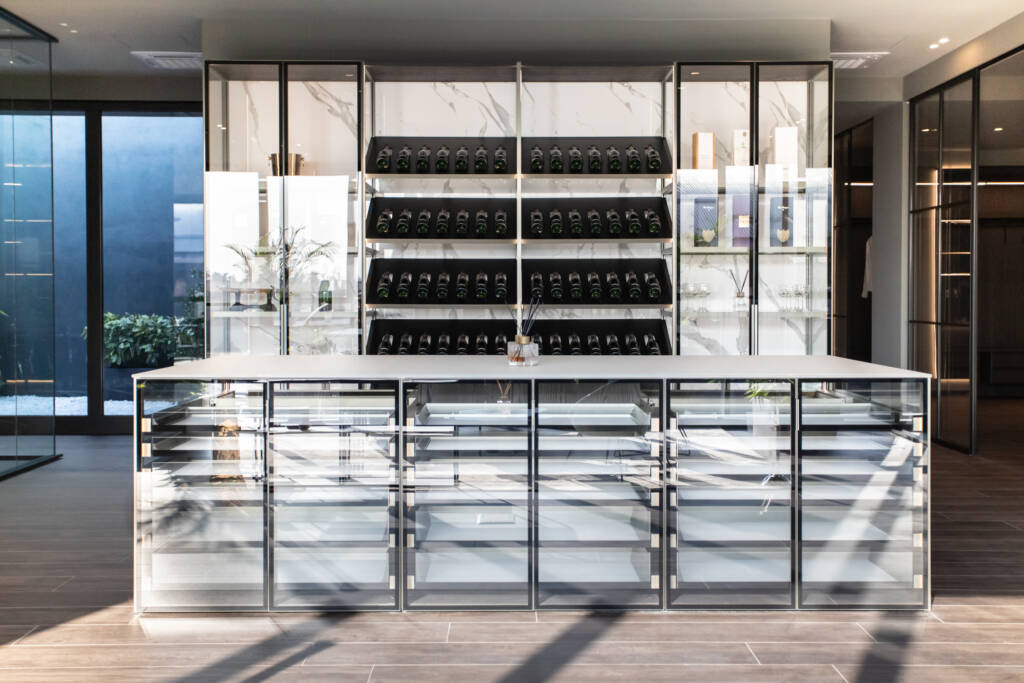
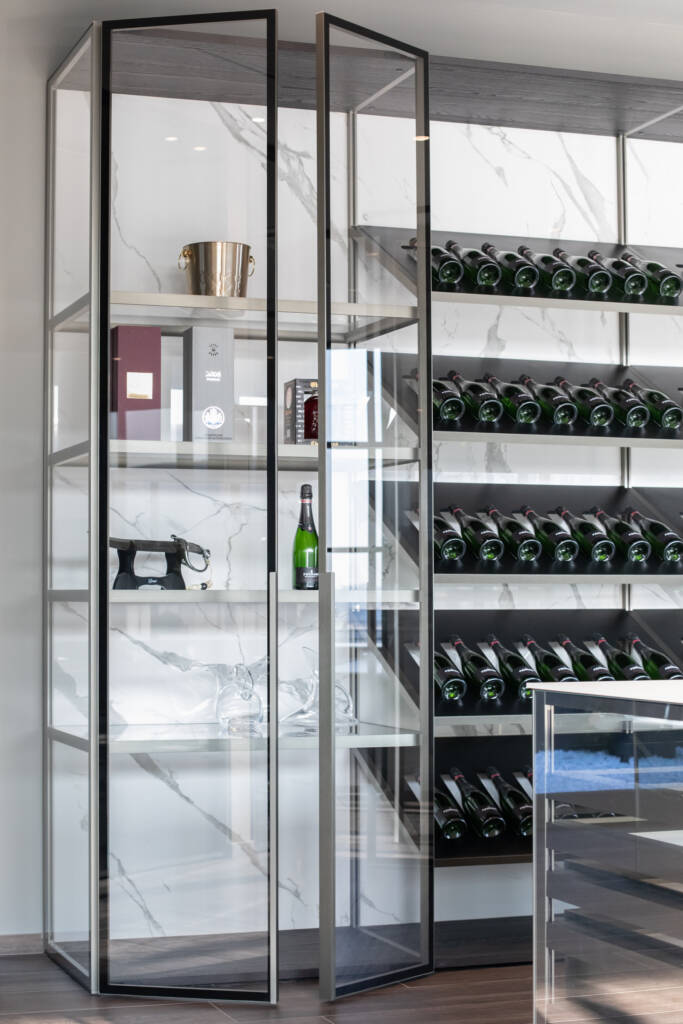
An aluminum frame cabinet door is a door constructed from precision-extruded aluminum profiles — typically a stile and rail system — that surround and secure a panel insert. The insert may be clear glass, frosted glass, fluted glass, a solid panel, or a decorative material such as acrylic. The aluminum profile forms the visible frame of the door and carries the structural load.
This construction differs fundamentally from a traditional wood frame door. Where a wood frame is machined from a natural material subject to grain variation and moisture movement, an aluminum profile is extruded under controlled conditions, delivering consistent geometry across every piece in a production run.
Profiles are available in a range of widths and geometries to suit different applications:
- Wide profiles (such as the IS-954 IKS) deliver a bold, statement-making frame with clean horizontal and vertical presence — suited to contemporary and transitional kitchen designs.
- Slim profiles (such as the VR-2020) produce a near-frameless look that maximizes the visual field of the insert — ideal for modern, minimalist interiors.
- Narrow classic profiles (such as the ISM-956 Mini IKS) offer a refined, timeless aesthetic that works equally well in residential kitchens, bathroom vanities, and built-in wardrobes.
Finishes are applied by powder coating or anodizing — not painting — and are available in black, bronze, sand, silver, and gold. This distinction matters for manufacturers, as it means the finish is integral to the surface of the profile, not a layer applied on top.
How Do Aluminum Frame Cabinet Doors Work?
The assembly follows a straightforward stile and rail method. The aluminum profiles are cut to the required length, mitered or corner-joined, and the panel insert is captured within the internal groove of the profile. For glass inserts, the fit is precise and consistent — the tolerances of an extruded aluminum profile mean the groove dimension is identical across every piece, which eliminates the fitting issues that can occur with routed wood grooves.
For furniture manufacturers, one of the most operationally significant aspects of aluminum frame profiles is that they arrive pre-finished. There is no painting, staining, lacquering, or UV-coating required on the shop floor. The door arrives at assembly already in its final surface condition.
It is worth noting that aluminum frame cabinet doors require compatible hinge hardware. Concealed European-style hinges — such as those manufactured by Blum — are the industry standard pairing. Hinge placement must be accounted for at the specification stage, as the aluminum frame’s wall thickness determines the available boring depth.
AluminumXDesign’s profiles are engineered with standard hinge compatibility in mind, and technical datasheets are available for each profile in the collection.
Expert Tip: When specifying aluminum frame profiles for high-volume production runs, always confirm the hinge boring specifications with your profile supplier before cutting. A mismatch between frame wall thickness and hinge cup depth is one of the most common — and most avoidable — sources of assembly rework.
The Key Advantages of Aluminum Frame Cabinet Doors
The following advantages are relevant to furniture manufacturers, cabinet makers, and commercial interior designers making sourcing decisions at a trade level. Each point is addressed from an operational perspective, not a consumer one.
1. Moisture and Corrosion Resistance
Aluminum does not absorb water. It will not swell, warp, crack, or delaminate in response to changes in humidity or direct moisture exposure. This makes aluminum frame cabinet doors the reliable choice for kitchens, bathrooms, commercial catering environments, and any installation where moisture is a regular factor.
For manufacturers, this has a direct commercial implication. A wood-frame door installed near a sink, dishwasher, or steam source carries a measurable risk of dimensional change over time. An aluminum frame door in the same position does not. The result is fewer warranty callbacks, lower after-sales service costs, and stronger client confidence in the finished product.
2. Dimensional Consistency Across Production Runs
This is the advantage that competing content almost universally misses — and it is arguably the most important for manufacturers operating at volume.
Because aluminum profiles are precision-extruded, the geometry of every piece is determined by the die, not by material variation. The same profile dimensions run on piece number one as on piece number five hundred. For production environments, this delivers three concrete benefits:
- Glass panel sizing is predictable — panels cut to a fixed dimension will fit consistently across every frame in the run.
- Assembly is faster — components fit without adjustment, reducing bench time per door.
- Quality control rejects are reduced — dimensional variation is virtually eliminated as a defect source.
Wood frames, by contrast, are subject to movement based on moisture content, grain direction, and species variation. Even with careful drying and machining, tolerance stack-up across a large run can result in glass panels that fit inconsistently.
Expert Tip: For large commercial projects requiring consistent aesthetics across many cabinets — such as hotel fit-outs or office buildouts — aluminum profiles from a single production batch will deliver finish and geometry uniformity that is simply not achievable with wood at scale. Request a batch certificate from your supplier to confirm production consistency.
3. Pre-Finished Profiles — No Post-Processing Required
Aluminum frame profiles are delivered in their finished state. Powder-coated and anodized surfaces require no additional treatment before installation. For manufacturers, this removes an entire step from the production workflow — and with it, the associated material cost, labor time, and drying or curing lead time.
The finish itself is also more durable than painted wood. Powder coating bonds to the aluminum surface through an electrostatic and thermal process, creating a finish that resists chipping, scratching, and UV degradation. It will not peel, bubble, or yellow over time the way painted finishes can. Anodized finishes go further — the oxide layer is actually part of the aluminum surface, not a coating applied on top, making it essentially permanent under normal use conditions.
4. Lightweight Without Sacrificing Structural Integrity
Aluminum has one of the best strength-to-weight ratios of any material used in cabinet construction. An aluminum frame door is significantly lighter than an equivalent wood-frame door, particularly at larger sizes.
For cabinet manufacturers, the weight advantage has practical implications across several areas:
- Hinge loading is reduced, extending the operational life of hardware.
- Lift-up and Aventos-style hinge systems work more efficiently with lighter doors, reducing actuator wear.
- Installation is easier and less fatiguing for fitting teams, particularly on tall wall cabinets.
- Shipping costs are lower for finished door batches, improving your margin on delivered projects.
5. Design Versatility Across Project Types
A single aluminum frame profile family can serve multiple product categories — kitchen cabinets, bathroom vanities, wardrobe systems, office furniture, and commercial cabinetry. For manufacturers developing diverse product lines, this reduces supplier and SKU .
complexity without limiting design options.
The range of available finishes — black, bronze, sand, silver, and gold — means the same profile can be specified across different client aesthetics without requiring separate inventory. Combined with a broad choice of insert types, including clear glass, frosted, fluted, back-painted, and solid panel, aluminum frame cabinet doors adapt to a wide variety of project requirements.
Expert Tip: When presenting aluminum frame door options to end clients, leading with finish and insert combinations — rather than profile dimensions — tends to be more effective. Clients respond to visual outcomes. A frosted glass insert in a bronze narrow frame reads very differently than the same insert in a black wide frame. Having physical samples of two or three finish combinations on hand during specification meetings significantly accelerates decision-making.
6. Longevity and Reduced Lifecycle Cost
Anodized and powder-coated aluminum profiles do not rust, chip, or delaminate under normal use conditions. For end clients — residential, commercial, or hospitality — this means a longer service life and a lower total cost of ownership compared to painted or veneer-faced wood alternatives.
For manufacturers and dealers, the lifecycle performance of aluminum frame cabinet doors supports a credible case for a premium price point. The argument is straightforward: the product costs more upfront and costs less over time. That is a practical conversation to have with procurement decision-makers, particularly on large-scale or repeat projects.
Where Aluminum Frame Cabinet Doors Perform Best
Understanding the right application for aluminum frame profiles helps manufacturers and designers specify with confidence. Below are the environments where the material’s advantages are most directly relevant.
- Performance is critical near moisture zones — sinks, dishwashers, steam ovens. Glass inserts add openness and light, and the premium aesthetic supports a higher price point for the overall installation.: High-end residential kitchens
- Humidity resistance is non-negotiable. Slim profiles work especially well in compact bathroom layouts, and the pre-finished surface handles cleaning products without degrading.: Bathroom vanities
- Durability and finish consistency across large orders are the primary drivers here. A hotel corridor with 200 identical aluminum frame cabinet doors needs every door to look the same on day one and five years later.: Commercial hospitality — hotels, restaurants, bars
- Clean, contemporary lines suit professional environments. Aluminum frame profiles integrate naturally into modular systems and support a consistent, branded interior aesthetic.: Office and built-in furniture
- Lightweight profiles reduce hinge and actuator wear. Glass inserts allow visibility into the cabinet without opening — a functional advantage clients genuinely value.: Wardrobe and closet systems
Aluminum Frame vs. Other Cabinet Door Frame Materials
The table below provides a direct comparison across the key performance factors that matter to furniture manufacturers and designers at the specification stage.
| Factor | Aluminum Frame | Wood Frame | Steel Frame | PVC Frame |
| Moisture Resistance | Excellent — will not swell, warp, or delaminate | Vulnerable — swells and warps with humidity | Moderate — depends on substrate | Adequate with coating |
| Finish Consistency | Pre-finished to tight tolerances across every run | Variable — grain and moisture affect results | Consistent but limited options | Moderate |
| Dimensional Tolerance | Precision-extruded — same every time | Changes with grain direction and moisture | Stable but limited profiles | Variable |
| Weight | Lightweight — excellent strength-to-weight ratio | Heavier, especially with glass | Heavy | Lightweight but less durable |
| Lifecycle | Decades with zero degradation if properly installed | Paint, veneer, and substrate degrade over time | Long but prone to chipping | Fades and warps over time |
| Design Versatility | Multiple profiles, finishes, and insert options | Limited by species, grain, and paint | Very limited | Limited |
| Maintenance | Wipe clean — no re-finishing needed | Re-painting or re-staining may be required | Chip repair needed | Cleaning only, no refinishing |
This comparison is not intended to suggest that aluminum is the right choice in every scenario. For traditional cabinetry styles where wood grain is a design requirement, or for budget-constrained projects where cost is the primary driver, other materials may be appropriate. The value of aluminum frame cabinet doors lies in matching the right material to the right project — and understanding clearly where each material’s strengths and limitations lie.
Expert Tip: When quoting aluminum frame profiles to clients who are comparing on price alone, the total cost of ownership calculation is your strongest argument. A higher upfront cost for a pre-finished, moisture-resistant, dimensionally stable profile typically results in lower warranty, rework, and replacement costs over the life of the installation. Build that math into your proposals.
FAQs
Are aluminum frame cabinet doors durable?
Yes. Aluminum frame cabinet doors are highly durable under normal residential and commercial use conditions. The material will not warp, swell, rust, or delaminate. Powder-coated and anodized finishes are resistant to chipping, UV degradation, and common cleaning products. With proper installation and hardware, aluminum frame cabinet doors have a service life that significantly exceeds painted or veneer-faced wood alternatives.
Do aluminum cabinet door frames rust?
No. Aluminum forms a natural oxide layer on its surface that prevents further oxidation. Unlike steel or iron, aluminum does not rust in humid or wet environments. This makes it particularly well-suited to kitchen and bathroom installations where moisture exposure is a regular factor.
Are aluminum frame doors more expensive than wood?
The upfront material cost is typically higher than standard painted wood frame doors. However, when total cost of ownership is considered — factoring in reduced finishing labor, fewer warranty claims, longer service life, and lower replacement rates — aluminum frame cabinet doors frequently represent a better investment over the lifecycle of a project. For manufacturers, the elimination of post-processing on the shop floor can also offset a significant portion of the material cost differential.
Can aluminum frame cabinet doors be used in bathrooms?
Yes, and they are an excellent choice for bathroom vanities specifically because of their moisture resistance. Aluminum will not swell or warp in high-humidity environments, and the pre-finished surface handles cleaning products without degrading. Slim profiles such as the VR-2020 are particularly well-suited to the tighter proportions typical of bathroom cabinet design.
What panel inserts work with aluminum frame cabinet doors?
Aluminum frame profiles accommodate a wide range of inserts depending on the groove depth and width of the specific profile. Common options include clear tempered glass, frosted glass, fluted or reeded glass, back-painted glass, solid aluminum panel, and acrylic. The choice of insert significantly affects the aesthetic outcome — from fully transparent to fully opaque — and should be considered alongside finish selection during the specification process.
Wrapping Up!
The advantages of aluminum frame cabinet doors are both material and operational. For furniture manufacturers and cabinet makers, the benefits extend beyond corrosion resistance and design aesthetics — they include consistent dimensions across production runs, elimination of post-processing on the shop floor, reduced warranty exposure, and a finished product that maintains its performance and appearance over the long term.
As North American cabinetry standards continue to align with European practice, aluminum frame profiles are becoming a reliable specification across premium residential, commercial, and hospitality projects.
AluminumXDesign manufactures a full range of Italian-designed aluminum frame cabinet door profiles from its USA facility. The collection includes wide, slim, narrow, solid, and classic geometries, available in multiple finishes. To discuss profile specifications for your next production run or project, contact the AluminumXDesign team directly.