Aluminum profiles come in a lot of shapes, and each one is built for a job. Some brace a corner. Some hold a panel or a sheet of glass. Some carry a load, and some frame a piece of furniture. Once you know the main types, picking the right one for a project gets a whole lot easier.
Let’s walk through how aluminum profiles are grouped, the main shapes you’ll run into, and where they show up in furniture and interiors.
How Aluminum Profiles Are Grouped
Before we get to the shapes, it helps to know that “type” can mean a few different things. Aluminum profiles get sorted in three main ways:
| Grouping method | What it looks at | The main options |
| By shape | The cross-section, or outline, of the profile | Angle, channel, T and T-slot, tube, bar and flat, box, specialty |
| By standard or custom | Whether the shape is stocked or made to order | Standard (off-the-shelf) or custom (made to order) |
| By internal form | Whether the shape encloses a cavity | Solid, hollow, or semi-hollow |
Most of the time, when someone says “type of profile,” they mean the shape. So that’s where we’ll start.
The Main Profile Types by Shape
Here are the shapes you’ll meet most often, what each one looks like, and what it’s good for.
Angle Profiles (L-Shaped)
An angle profile has two sides that meet at a right angle, so the cross-section looks like the letter L. It’s one of the simplest and most useful shapes around.
Angle profiles are the go-to for corners. They brace a joint, protect an exposed edge, and add support wherever two surfaces meet. In furniture and framing, you’ll see them used for edging, trim, and corner reinforcement.
Channel Profiles (U and C)
A channel profile has an open side, so the cross-section looks like a U or a C. That open groove is the whole point, since it holds things.
Channels are used to hold a panel or a sheet of glass, cover a raw edge, or run cabling out of sight. In furniture, a channel profile is what grips a glass insert in a door or holds a wood panel in place.
T Profiles and T-Slot Profiles
A T profile has a cross-section shaped like the letter T, used for joints and support. There’s also a modular version called the T-slot profile, which has a continuous T-shaped groove running along its length.
That groove lets you bolt parts together without welding. You slide a fastener into the slot, and it locks the pieces together. T-slot profiles are mostly an industrial thing, used to build machine frames, workstations, and enclosures, where people need to assemble and reconfigure a frame quickly.
Tube Profiles (Round, Square, Rectangular)
A tube profile is hollow, with an enclosed cavity inside. It comes in round, square, and rectangular versions. Being hollow makes it strong for its weight, which is why it turns up so often.
Tube profiles work well for rails, legs, and frames. In furniture, a round or square tube is what makes a clothes-hanging rail or the frame of a table or cabinet.
Bar and Flat Profiles
A bar profile is solid all the way through, with no hollow inside. It comes flat, round, or square. Simple, but strong and steady.
Bars and flats are used for reinforcement, brackets, trim, and railings. In furniture, a flat bar can add an edge detail or a bit of extra support where it’s needed.
Box Profiles
A box profile is a closed square or rectangular section. Because it’s closed on all sides, it’s strong and good at carrying a load.
Box profiles are used for posts, beams, and sturdy frames. They show up in structural work and in furniture that needs to hold real weight.
Specialty Shapes
Beyond the common shapes, there’s a long list of specialty profiles. These include other letter shapes like H, Z, and J, along with industrial framing shapes sometimes called sigma, and the V-slot profile.
A V-slot has a beveled groove that doubles as a track, so wheels and sliders can run along it. That makes it handy for motion systems. Naming for some of these varies from one maker to the next, and most of them are used in industrial and machine work rather than furniture.
Solid, Hollow, and Semi-Hollow Profiles
You saw solid and hollow come up a few times above, so here’s the quick version of that classification. The Aluminum Extruders Council describes extruded shapes in three general categories: solid, hollow, and semi-hollow. It comes down to what’s going on inside the profile:
- Solid profiles have no enclosed gaps. A bar or an angle is solid.
- Hollow profiles have a fully enclosed cavity. A tube is hollow.
- Semi-hollow profiles sit in between, with a partly enclosed pocket rather than a fully closed one.
This matters because it changes the weight, the strength, and the cost. A hollow profile gives you good strength without much weight, while a solid one is heavier but simple and stiff.
Standard vs. Custom Profiles
Another way profiles split is standard versus custom, and the difference is pretty practical.
- Standard profiles are common shapes kept in stock. They’re quick to get and cost less, and they cover most jobs just fine.
- Custom profiles are made to order for an exact shape or size. They’re the answer when a standard shape won’t do what you need, though they take more time and cost more.
The rule of thumb is simple. Use a standard shape when one fits the job, and go custom when a design needs something a stock profile can’t give you cleanly.
Profiles Used in Furniture and Interiors
So which of these actually show up in furniture and interior work? Here’s how the shapes map to real jobs:
- Frame profiles for cabinet doors and wardrobes
- Tube profiles for hanging rails and structural frames
- Channel profiles to hold glass or wood panels
- Angle and bar profiles for edges, trim, and reinforcement
- Track and sliding profiles for sliding doors and partitions
One thing to keep in mind: furniture doesn’t ask a profile to carry a heavy structural load the way a building frame does. What matters more is a clean shape and a good finish, since the profile is often on show. That’s why furniture leans on frame, tube, and channel profiles rather than the heavy box and industrial framing shapes.
A Note on Alloys and Finishes
Two quick points that round out the picture, since a profile is more than its shape.
Most furniture and interior profiles use a 6000-series aluminum alloy, such as 6063. This family shapes into detailed profiles cleanly and takes a good finish, which is exactly what you want for visible furniture parts.
For the finish itself, profiles are usually anodized or powder-coated. Both come in a range of colors and textures, and they set the look of the profile along with a layer of surface protection.
Aluminum X Design Profiles by Type
A good way to see these profile types in practice is to look at how they work in real furniture. Aluminum X Design makes interior and furniture profiles, so its range lines up with several of the shapes covered above.
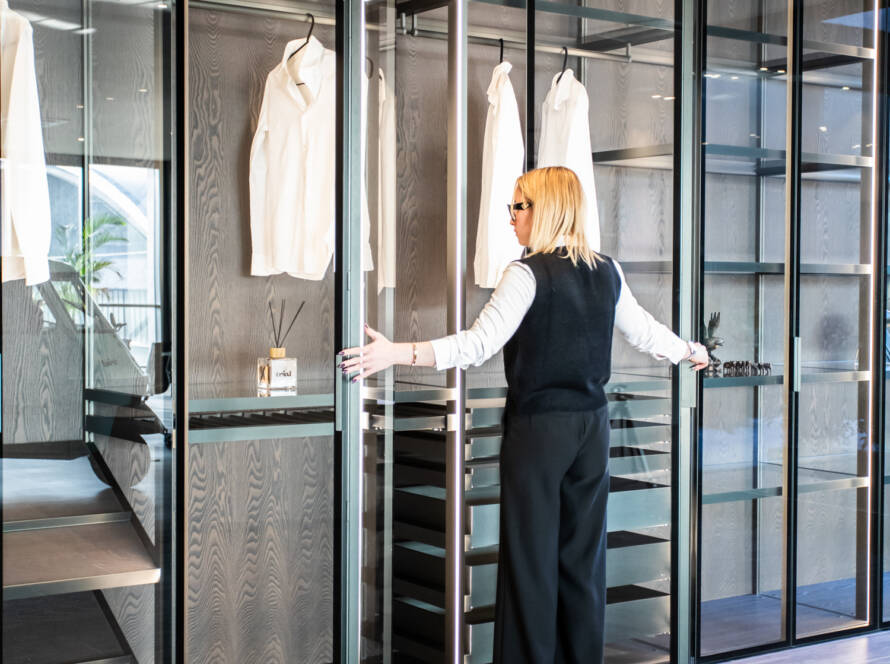
- Frame profiles shape the structure of cabinet door frames and wardrobe systems, and the frame and back profiles hold a glass or wood panel.
- Tube profiles form the clothes-hanging rails, made in both square and round versions.
- Angled profiles support the shelves in the shoe rack storage.
- Sliding door profiles run the sliding door and partition systems for dividing a room, and hinged door profiles handle the cabinetry doors.
Here’s how the shapes line up with the products:
| Profile type | Where it shows up |
| Frame profiles | Cabinet door frames, wardrobe structures |
| Tube profiles (square and round) | Clothes-hanging rails |
| Frame and back profiles | Hold glass or wood panels in doors, sides, and backs |
| Angled profiles | Shoe rack shelf storage |
| Sliding door profiles | Sliding doors and room partitions |
Across the range, the profiles are anodized in black, bronze, and sand, and they’re Italian-designed and made at the Chatsworth, California, facility. A cross-section tells you far more in the hand than in a photo, so the California showroom lets you look at each profile type up close, by appointment.
Conclusion
Aluminum profiles come in a range of shapes, from angles and channels to tubes, bars, and boxes, plus the modular T-slot and a handful of specialty forms. Each shape suits a different job, whether that’s bracing a corner, holding a panel, or framing a cabinet. For furniture and interiors, frame, tube, and channel profiles do most of the work, backed by a 6000-series alloy and a clean anodized or powder-coated finish.
Once you can tell one shape from another, matching the profile to the job stops being guesswork. Aluminum X Design designs and manufactures furniture and interior profiles at its Chatsworth, California facility, working with cabinet makers, furniture manufacturers, and interior designers across the US.
If you’re trying to figure out which profile type fits what you’re building, send us the details of your project and our team will point you to the right one.
Frequently Asked Questions
What are the main types of aluminum profiles?
The main types are named by shape: angle (L), channel (U or C), T and T-slot, tube (round, square, or rectangular), bar and flat, and box profiles. There are also specialty shapes like H, Z, and V-slot profiles for more specific jobs.
What is the difference between a channel and an angle profile?
An angle profile has two sides meeting at a right angle, shaped like an L, and it’s used for corners, edges, and bracing. A channel profile has an open U or C shape with a groove that holds panels, glass, or cabling.
What is the difference between solid, hollow, and semi-hollow profiles?
Solid profiles have no enclosed gaps, like a bar or an angle. Hollow profiles have a fully enclosed cavity, like a tube. Semi-hollow profiles sit in between, with a partly enclosed pocket. The difference affects weight, strength, and cost.
What is the difference between standard and custom profiles?
Standard profiles are common shapes kept in stock, so they’re quick to get and cost less. Custom profiles are made to order for an exact shape or size, which suits a specific design but adds cost and lead time.
Which aluminum profiles are used in furniture?
Furniture mostly uses frame profiles for doors and wardrobes, tube profiles for hanging rails and frames, and channel profiles to hold glass or wood panels. Angle and bar profiles handle edges, trim, and reinforcement.
Which aluminum alloy is used for profiles?
Most furniture and interior profiles use a 6000-series alloy, such as 6063. It shapes into detailed profiles cleanly and takes anodizing and powder coating well, which makes it a good fit for visible furniture parts.